


 साझा अर्थ संवाददाता
२३ असार २०८३, मङ्गलवार
साझा अर्थ संवाददाता
२३ असार २०८३, मङ्गलवार
Nepal Rastra Bank’s annual review of the monetary policy for fiscal year 2082/83 presents a mixed picture of the economy. The headline indicators suggest stability: inflation is within the central bank’s target, foreign exchange reserves are comfortable, the banking system has excess liquidity, and interest rates have declined. But the same review also shows that domestic economic momentum remains weak, with private-sector credit growth far below the level projected by the central bank.
The review, therefore, is not simply a report of macroeconomic comfort. It is also a reminder that stability in financial indicators has not yet translated into stronger borrowing, investment, construction activity or business expansion.
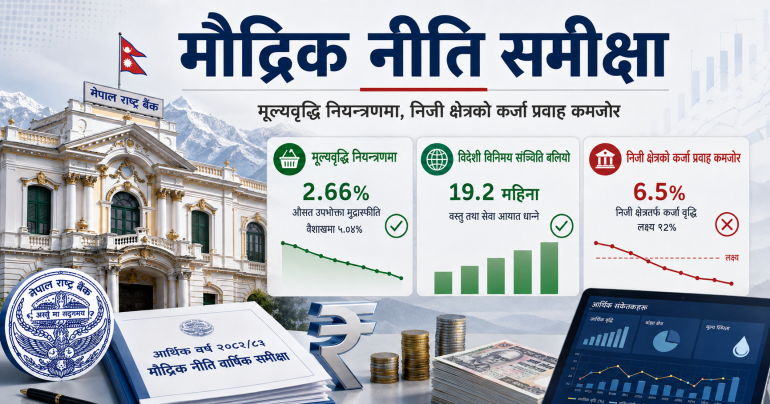
NRB had aimed to keep inflation within 5 percent in FY 2082/83. According to the review, average consumer inflation during the first ten months of the fiscal year stood at 2.66 percent, while year-on-year inflation in Baisakh 2083 was 5.04 percent. This shows that price pressure remained broadly within the monetary policy objective.
The external sector also remained comfortable. NRB had targeted foreign exchange reserves sufficient to cover at least seven months of goods and services imports. By Baisakh 2083, reserves were sufficient to cover 19.2 months of goods and services imports. The annex to the review further states that reserves were enough to cover 22.6 months of merchandise imports and 19.2 months of goods and services imports.
These figures indicate that Nepal is not facing immediate external pressure under the conditions shown in the review. The country has a strong foreign exchange buffer, giving policymakers room to focus more on reviving domestic economic activity.
The strongest warning in the review comes from credit growth.
For FY 2082/83, NRB had projected broad money growth of 13 percent and private-sector credit growth of up to 12 percent. By Baisakh 2083, broad money growth had reached 15.2 percent, but private-sector credit growth stood at only 6.5 percent in the main review text. The annex separately reports private-sector credit from banks and financial institutions growing by 6.7 percent.
This gap is important. It shows that liquidity exists in the financial system, but it has not moved into the private sector at the pace expected by the central bank. In other words, the banking system has money, but demand for credit remains weak.
NRB’s own diagnosis points to multiple reasons behind this weakness. The review mentions delayed monsoon conditions, excessive rainfall in Ashoj, lower agricultural production, the difficult situation following the Bhadra 23 and 24 movement, weak private-sector morale and limited business expansion as factors that pressured aggregate demand. It also identifies decline in foreign trade, slow public and private construction, and uncertainty related to land plotting and power purchase agreements as factors that prevented credit flow from increasing as expected.
The review further notes that weaker-than-expected economic activity and the quality of loans issued in the past contributed to an increase in non-performing loans, reducing banks’ lending capacity. At the same time, money entering the financial system through remittance inflows continued to add liquidity, while credit flow and investment did not grow as expected. This kept excess liquidity in the banking system.
The review confirms that excess liquidity has pushed short-term interest rates near the lower end of the interest-rate corridor.
In Baisakh 2083, the weighted average interbank rate stood at 2.75 percent, while the weighted average 91-day treasury bill rate stood at 2.63 percent. Commercial banks’ average deposit rate was 3.35 percent, while their weighted average lending rate stood at 6.73 percent. Development banks and finance companies had weighted average lending rates of 7.87 percent and 9.14 percent respectively.
NRB also absorbed liquidity through several instruments during the first ten months of the fiscal year. The review states that liquidity was mopped up through deposit collection auctions, the standing deposit facility and one-year NRB bonds. By Baisakh 2083, outstanding liquidity absorption through deposit collection auctions stood at Rs. 716.70 billion, through the standing deposit facility at Rs. 111.90 billion, and through NRB bonds at Rs. 200 billion.
These figures reinforce the central point of the review: the problem is not a shortage of liquidity. The larger challenge is weak credit demand and weak transmission of available liquidity into productive economic activity.
NRB has taken several measures to make credit conditions more flexible.
The review states that the working capital loan guidelines were revised by incorporating the nature of business, repayment-income cycle and related arrangements. Banks and financial institutions may determine the tenure of permanent working capital loans based on the nature of the enterprise, sector, cash flow and working capital analysis.
The housing loan limit for private residential construction or purchase was increased from Rs. 2 crore to Rs. 3 crore. For first-home construction or purchase, the loan-to-value ratio may be maintained up to 80 percent, while for other cases it may be maintained up to 70 percent.
For micro, small and medium enterprises, NRB amended the digital lending guidelines to allow digital loans of up to Rs. 10 lakh. The review also states that banks and financial institutions may work with technology service providers for credit analysis under this framework.
In agriculture and small business lending, NRB allowed collateral valuation for loans up to Rs. 10 lakh to be conducted by staff of banks and financial institutions. It also required agricultural loan repayment schedules to be aligned with the nature of agricultural output and production, including the timing of harvest, sale and loan installment payment.
The personal overdraft limit was increased from Rs. 50 lakh to Rs. 1 crore. NRB also raised the single-customer limit for margin-type loans against share collateral from Rs. 15 crore to Rs. 25 crore.
One important regulatory issue in the review concerns cheque dishonour and blacklisting.
The annex states that policy facilitation regarding the existing arrangement of blacklisting due to cheque dishonour is under study. This means the issue has been formally recognized by NRB, but the review does not state that any final relief has already been implemented.
This distinction is important. For businesses facing temporary cash-flow problems, blacklisting can restrict access to formal banking channels and deepen financial stress. However, any policy change will also need to preserve payment discipline and prevent misuse by willful defaulters.
While the monetary stance has been flexible, the review also shows that NRB is paying attention to financial-sector risk.
A loan portfolio review of 10 large commercial banks was completed through an independent party, and the report was sent to the concerned banks for implementation. NRB also issued the Framework for Dealing with Domestic Systemically Important Banks, 2025, and a framework for identifying systemically important payment systems.
This indicates that NRB is trying to balance two objectives: supporting credit flow and economic activity, while also maintaining discipline in the banking system amid rising concerns over loan quality.
The review does not show an economy in immediate macroeconomic distress. Inflation is within target, foreign exchange reserves are strong, and liquidity is abundant. These are positive signs.
But the review also shows that Nepal’s domestic economy has not responded strongly to easier monetary conditions. The clearest evidence is the gap between broad money growth and private-sector credit growth. Broad money expanded by 15.2 percent, while private-sector credit growth remained around 6.5 to 6.7 percent, far below the projection of up to 12 percent.
This suggests that the current challenge is not primarily liquidity. It is confidence, demand and credit absorption.
For businesses, lower interest rates reduce borrowing costs, but they do not automatically create sales. Unless demand improves and uncertainty declines, firms may remain cautious about taking new loans, expanding inventory or hiring additional workers.
For investors, particularly in the share market, low interest rates and higher margin-lending limits can support market sentiment. But the review itself does not forecast a stock market rally. Any capital-market optimism should therefore be treated as an interpretation of liquidity conditions, not as a direct statement by NRB. A sustainable market rise would still require stronger corporate earnings and broader improvement in economic activity.
For policymakers, the message is equally clear: monetary policy has created supportive conditions, but recovery will depend on whether those conditions translate into real-sector activity. Credit growth, construction activity, business confidence and loan quality will be key indicators to watch.
NRB’s annual review presents Nepal as financially stable but economically hesitant.
The positive side is clear. Inflation is broadly within target. Foreign exchange reserves are comfortable. The banking system has excess liquidity. Interest rates have declined. Several credit-related rules have been made more flexible.
But the weaker side is equally clear. Private-sector credit growth remains well below the projected level. Public and private construction activity has been slow. Uncertainty in land plotting and power purchase agreements has affected credit flow. Non-performing loans have weakened banks’ lending capacity. Liquidity is available, but investment and borrowing have not expanded as expected.
The review therefore should not be read as a sign of full recovery. It is better understood as a stability report with an underlying warning: Nepal has created the monetary conditions for recovery, but the domestic economy has not yet regained sufficient momentum.
The final message is simple. Nepal does not currently face a liquidity shortage. Its bigger challenge is to restore confidence, strengthen credit demand and convert financial stability into real economic activity.