


 साझा अर्थ संवाददाता
२६ माघ २०८२, सोमवार
साझा अर्थ संवाददाता
२६ माघ २०८२, सोमवार
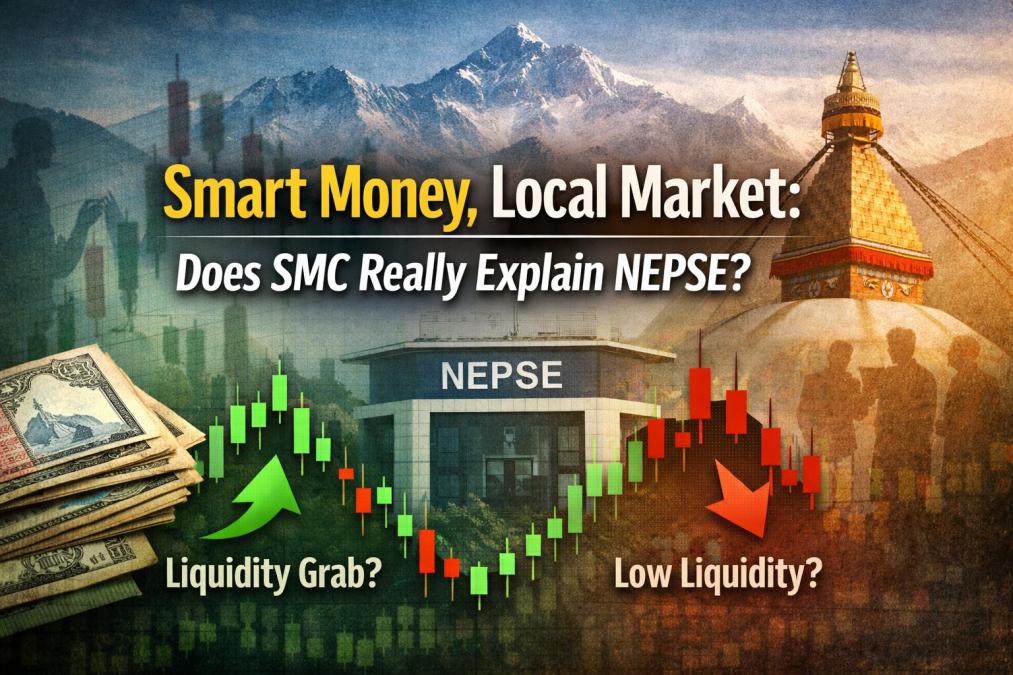
Over the last few years, Nepal’s trading ecosystem has absorbed a new vocabulary. Terms such as Smart Money Concept (SMC), ICT, liquidity grabs, order blocks, and fair value gaps—once confined to global Forex and index tradersar e now commonly used in NEPSE discussions, YouTube videos, and Telegram groups.
For many traders, these concepts appear to offer something traditional indicators failed to provide: an explanation for sudden reversals, false breakouts, and emotionally painful losses. Every sharp move in banking, hydropower, or microfinance stocks now seems to have a label.
But an important question deserves attention:
Are these global trading frameworks genuinely explaining NEPSE’s price behavior or are they being force-fitted into a market with fundamentally different dynamics?
Most retail traders in Nepal begin with familiar tools RSI signals, moving-average crossovers, broker recommendations, or social-media tips. Initially, these methods seem to work. Over time, however, repeated losses create frustration and a deeper need for answers.
SMC fills that gap well. It does not merely say when to buy or sell; it claims to explain why the market moves. Clean charts, confident narratives, and institutional-sounding logic make the framework psychologically appealing especially after traders experience unexpected reversals.
The problem begins when explanation is mistaken for prediction.
NEPSE is not Forex. It is not Nasdaq. And it is certainly not a high-frequency, algorithm-driven market.
Its defining characteristics are very different:
Participation is overwhelmingly retail-driven
Institutional trading depth is limited
Liquidity is thin in most stocks
Promoters and large individual investors influence price more than automated systems
Sector-wide sentiment often overrides stock-specific logic
In global markets, “smart money” usually refers to large institutions executing complex strategies at scale. In NEPSE, so-called smart money is far more fragmented—often long-term investors, promoters, or well-capitalized individuals with fundamentally different incentives.
Applying institutional execution models without adaptation creates distorted expectations.
A common NEPSE scenario is familiar to most traders:
A stock breaks a well-known resistance level. Retail buying accelerates. Volume spikes. Then, price reverses sharply.
This is frequently labeled as a liquidity grab or stop hunt. Yet in most cases, the explanation is far simpler.
Early entrants book profits. Order books lack depth. Late buyers panic. With limited liquidity to absorb selling pressure, price falls faster than expected.
What looks like manipulation is often just basic demand–supply imbalance in a thin market.
This does not mean SMC-related thinking is entirely irrelevant to NEPSE. Some principles do align with observed behavior:
Price often reacts near previous highs and lows due to profit booking and trapped traders
Trend deterioration from higher highs to lower highs frequently precedes prolonged corrections
Structural shifts matter more than precise entry timing
Used flexibly, these ideas can help traders avoid obvious mistakes, particularly during late-stage rallies or extended consolidations.
Problems arise when global models are applied rigidly:
Fair value gaps in low-liquidity stocks often fill randomly
Order blocks are highly subjective without transparent volume confirmation
Time-based ICT execution models have little relevance in NEPSE
When concepts turn into fixed rules, they stop being tools and become sources of false confidence.
Perhaps the most harmful assumption spreading among traders today is this:
“Once I learn this framework, my losses will stop.”
In reality, most losses in NEPSE stem from:
Overtrading
Poor risk management
Emotional attachment to stocks
Ignoring broader market trends
No analytical framework SMC included solves these problems. Discipline does.
In practice, many traders use SMC not as a decision-making framework, but as a post-loss justification mechanism. Two traders can draw entirely different “order blocks” on the same chart and both feel confident they are correct. That subjectivity should itself be a warning.
For NEPSE participants, priority should be given to:
Understanding sector rotation
Respecting overall market direction
Managing risk before seeking precision
Studying historical behavior of local stocks
SMC can be one layer of analysis but it should not be the foundation.
The rise of Smart Money Concept in Nepal reflects a healthy curiosity among traders who want to understand markets more deeply. That curiosity should be encouraged. However, NEPSE is not a fully institutional market, and importing global trading models without adjustment creates unrealistic expectations.
SMC is neither magic nor meaningless. In Nepal’s context, it works best when simplified, grounded in local realities, and combined with patience, discipline, and sound risk management.
There is no shortcut to consistency in NEPSE only learning, restraint, and survival.