


 साझा अर्थ संवाददाता
१२ कार्तिक २०८२, बुधवार
साझा अर्थ संवाददाता
१२ कार्तिक २०८२, बुधवार
India–China Rivalry Shapes Indo-Pacific: Nepal’s Strategic Role Highlighted
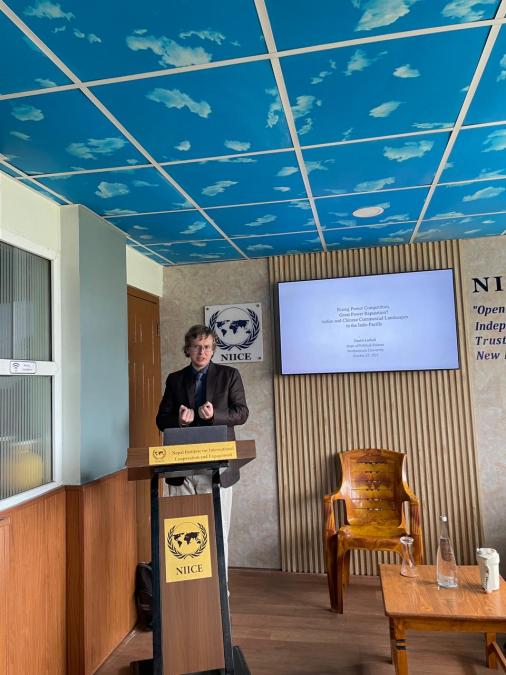
Kathmandu - The Nepal Institute for International Cooperation and Engagement (NIICE) organized a public lecture titled “Rising Power Competition: Indian and Chinese Commercial Landscapes in the Indo-Pacific” at its seminar hall in Hattiban, Lalitpur, on Monday.
Delivering the lecture, Mr. Daniel Loebell, PhD candidate in Political Science at Northwestern University, USA, discussed how the growing strategic and economic rivalry between India and China is reshaping the Indo-Pacific region and influencing smaller South Asian states, including Nepal and Malaysia.
In his opening remarks, Bibek Dhoj Thapa, Program Coordinator at NIICE, explained why NIICE has been studying the Indo-Pacific framework, emphasizing that the concept extends beyond coastal states. He noted that Nepal can be seen as a “virtual maritime country” due to its open border with India and its participation in BIMSTEC, which provides indirect access to the Indian Ocean.
Mr. Loebell highlighted that as India strengthens its maritime partnerships, especially with the United States, China has become more assertive along the Himalayan border. “Tensions in the Indo-Pacific waters are mirrored in the Himalayas,” he remarked, underscoring that both regions are interlinked arenas of great-power competition.
Drawing from his fieldwork in Nepal, Mr. Loebell shared findings from over 40 semi-structured interviews with officials, academics, and private-sector representatives. His research suggests that India’s commercial and institutional influence in Nepal remains stronger than China’s, particularly in trade, investment, and non-profit exchanges.
He further described Nepal’s geographic position between India and China as a strategic observation point for studying the regional balance of power. His research, he said, explores how small states hedge between large powers to maintain sovereignty while pursuing economic engagement.
Mr. Loebell also discussed his comparative research in Malaysia, noting that both Nepal and Malaysia share deep historical and cultural ties with India and China that predate British colonial influence. He traced Malaysia’s transregional connections as far back as 900 years, citing trade between the Kedah city-state, the Chola Empire and China as early examples of globalization.
Acknowledging the support of the Northwestern Buffett Institute for Global Studies, Mr. Loebell emphasized the importance of continued academic collaboration between Nepali and international institutions to better understand the region’s shifting political and economic dynamics.
The lecture was attended by over 20 participants, including researchers, diplomats, academics, and students from various universities and think tanks. The event concluded with an interactive Q&A session, where participants discussed the strategic opportunities for Nepal and Malaysia within the broader Indo-Pacific context.